Currently Empty: R0.00

UF Recovery Rate: What It Means for Water Treatment
The UF recovery rate is an important measure of how efficiently an ultrafiltration (UF) system converts incoming feed water into usable filtered water. Whether a UF system is installed in a home, commercial building, or industrial facility, understanding its recovery rate helps optimise water production, minimise waste, and improve overall system performance.
Unlike reverse osmosis systems, ultrafiltration generally produces very high recovery rates because the membrane removes suspended contaminants rather than dissolved salts. However, factors such as feed water quality, system design and maintenance still influence the final recovery rate.
By understanding the UF recovery rate, system owners can make informed decisions that improve efficiency while maintaining reliable water quality.
What Is UF Recovery Rate?
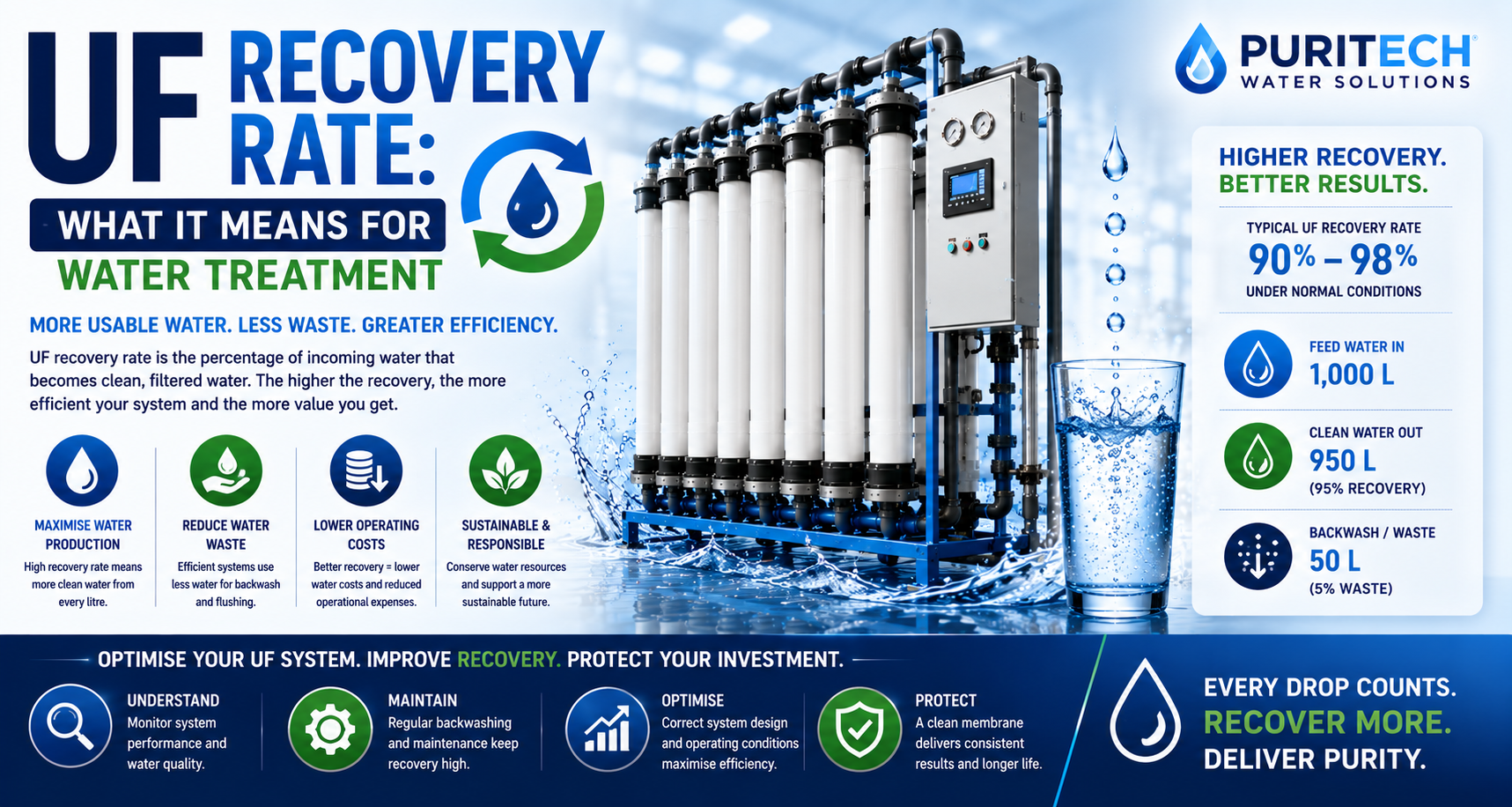
The UF recovery rate is the percentage of incoming water that passes through the ultrafiltration membrane as treated water.
The remaining water is used during flushing or backwashing to remove contaminants from the membrane surface.
For example:
- Feed water: 1,000 litres
- Filtered water: 950 litres
- Backwash and waste water: 50 litres
In this example, the recovery rate is 95%.
Why Recovery Rate Matters
A higher recovery rate means more of the incoming water is converted into usable water.
Benefits include:
- Better water efficiency
- Lower operating costs
- Reduced water wastage
- Improved sustainability
- More effective use of available water resources
However, chasing the highest possible recovery rate is not always the best approach. Systems must still allow sufficient flushing and backwashing to keep the membrane clean and operating efficiently.
Typical UF Recovery Rates
Recovery rates vary depending on system design and operating conditions.
Many ultrafiltration systems operate within a recovery range of:
- 90%–98% under normal conditions
The exact value depends on:
- Feed water quality
- Membrane design
- Backwash frequency
- Operating pressure
- System configuration
Manufacturers design systems to balance water recovery with membrane protection and long-term reliability.
Factors That Affect UF Recovery Rate
Several variables influence UF recovery rate.
Feed Water Quality
Water containing high levels of suspended solids or organic matter may require more frequent backwashing, reducing the overall recovery rate.
Backwashing Frequency
Regular backwashing protects the membrane, but it also uses water.
Systems with more frequent cleaning cycles generally have slightly lower recovery rates.
Membrane Fouling
As fouling increases, water flow decreases, and cleaning frequency may increase.
Routine maintenance helps maintain a stable recovery rate.
System Design
A properly designed ultrafiltration system balances water production, membrane protection, and operating efficiency.
Correct sizing plays an important role in achieving consistent recovery rates.
Operating Conditions
Pressure, flow rate and daily water demand all influence recovery performance.
Following the manufacturer’s operating recommendations helps maintain efficient water production.
How to Improve UF Recovery Rate
Improving UF recovery rate is not simply about producing more filtered water. The goal is to maximise efficiency while protecting the ultrafiltration membrane and maintaining consistent water quality.
Start with a water analysis
A professional water analysis provides valuable information about the quality of the incoming water.
Understanding factors such as suspended solids, turbidity, iron, manganese, and organic matter allows the system to be designed correctly from the beginning.
Proper system design is one of the most effective ways to achieve an efficient UF recovery rate.
Install Suitable Pre-Treatment
Removing larger contaminants before they reach the ultrafiltration membrane reduces fouling and improves overall system efficiency.
Depending on the water source, pre-treatment may include the following:
- Sediment filtration
- Activated carbon filtration
- Iron and manganese removal
- Water softening
Appropriate pre-treatment helps maintain stable recovery rates over the long term.
Keep the Membrane Clean
Routine backwashing and scheduled maintenance prevent excessive fouling.
A clean membrane allows water to flow more freely, supporting efficient water production while reducing unnecessary cleaning cycles.
Operate Within Recommended Limits
Ultrafiltration systems should always operate within the manufacturer’s recommended pressure and flow range.
Excessive pressure or incorrect flow rates can reduce efficiency and place unnecessary stress on the membrane.
Replace Consumables on Schedule
Blocked sediment filters and worn components reduce overall system performance.
Replacing consumable parts at the recommended intervals helps maintain an efficient UF recovery rate.
Common Misconceptions About UF Recovery Rate
Several misconceptions often lead to unrealistic expectations.
Higher Recovery Is Always Better
Not necessarily.
Although a high recovery rate improves water efficiency, the membrane still requires sufficient backwashing to remove accumulated contaminants.
Reducing cleaning simply to increase recovery can shorten membrane life.
Recovery Rate Never Changes
The recovery rate can change over time as feedwater quality, operating conditions, and membrane condition change.
Routine monitoring helps maintain consistent performance.
Every UF System Has the Same Recovery Rate
Recovery rates vary depending on:
- Water quality
- System design
- Membrane type
- Cleaning schedule
- Daily water demand
Each installation should be evaluated individually.
Frequently Asked Questions
What is a good UF recovery rate?
Many ultrafiltration systems achieve recovery rates between 90% and 98%, depending on water quality, system design and operating conditions.
Does poor water quality reduce UF recovery rate?
Yes. Water containing high levels of suspended solids or organic matter often requires more frequent backwashing, which can reduce the overall recovery rate.
Can maintenance improve UF recovery rate?
Yes. Regular cleaning, timely replacement of consumable filters, and routine inspections help maintain efficient membrane performance and stable recovery rates.
Is the UF recovery rate the same as the reverse osmosis recovery?
No. Ultrafiltration and reverse osmosis use different membrane technologies and remove different types of contaminants. Consequently, their recovery rates and operating principles differ.
Conclusion
Understanding UF recovery rate helps system owners evaluate the efficiency of their ultrafiltration systems while balancing water production, membrane protection and long-term performance. Although ultrafiltration systems generally achieve high recovery rates, factors such as feed water quality, pre-treatment, operating conditions and maintenance all influence the final result.
Rather than focusing only on maximising water recovery, the objective should be to maintain a stable recovery rate that supports reliable filtration and protects the membrane. A professional water analysis, proper system design and routine maintenance all contribute to efficient operation and dependable water quality.
By managing these factors effectively, homeowners, businesses, industries and municipalities can maximise the benefits of ultrafiltration while minimising operating costs and water waste.